Questions?
Call (800) 583-4891
Blankets, mats, tubular socks, and fabrics that protect topsoil on slopes and embankments — from temporary, degradable products through permanent, multi-year installations. Meeting ECTC and FHWA standards, with free shipping on every order.
Erosion is a natural occurrence that can be both environmentally damaging and costly if not prevented against. When large amounts of water wash away hillside soil it can be a nightmare to fix, and hillside erosion where homes or businesses are located can give way to landslides and property damage. Dredging sediment-filled waterways due to soil erosion costs the US government roughly $1B per year on average.
To prevent hillside erosion and embankment soil loss, erosion control products are recommended by federal and state municipalities along with private industry. These products are engineered to provide extra stability and allow time for natural vegetation to take root and secure the earth. Below, use the lifespan chart and the Product Finder to reach the right product, then dig into the category descriptions and installation resources further down.
Temporary applications from 45–90 days through long-term permanent installations of 5+ years. Biodegradable options plus solutions for hard-to-maintain sloped hillsides and embankments.
Four core paths cover most projects. Not sure which fits? The Product Finder narrows it in three questions.
 Erosion Control Blankets
Temporary to semi-permanent. Establishes vegetation on slopes and channels; 45 days–36 months.
Browse Blankets
Erosion Control Blankets
Temporary to semi-permanent. Establishes vegetation on slopes and channels; 45 days–36 months.
Browse Blankets
 Silt Socks
Tubular sediment filters for inlet protection, check dams, and perimeter control. A better alternative to silt fence.
Browse Silt Socks
Silt Socks
Tubular sediment filters for inlet protection, check dams, and perimeter control. A better alternative to silt fence.
Browse Silt Socks
 Turf Reinforcement Mats
Permanent, non-degradable reinforcement for steep slopes, high-flow channels, and inlet/outlet zones.
Browse TRMs
Turf Reinforcement Mats
Permanent, non-degradable reinforcement for steep slopes, high-flow channels, and inlet/outlet zones.
Browse TRMs
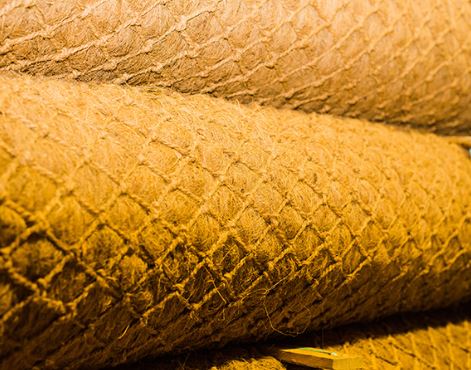 Coir Mats & Logs
100% natural coconut fiber for shoreline, wetland, and high-flow scenarios. Biodegrades in 2–5 years.
Browse Coir
Coir Mats & Logs
100% natural coconut fiber for shoreline, wetland, and high-flow scenarios. Biodegrades in 2–5 years.
Browse Coir
Answer a few questions to find the right product for your project.
Match the product to your project timeline. Temporary products establish vegetation and then degrade; permanent products stay in place to reinforce it for the long haul.

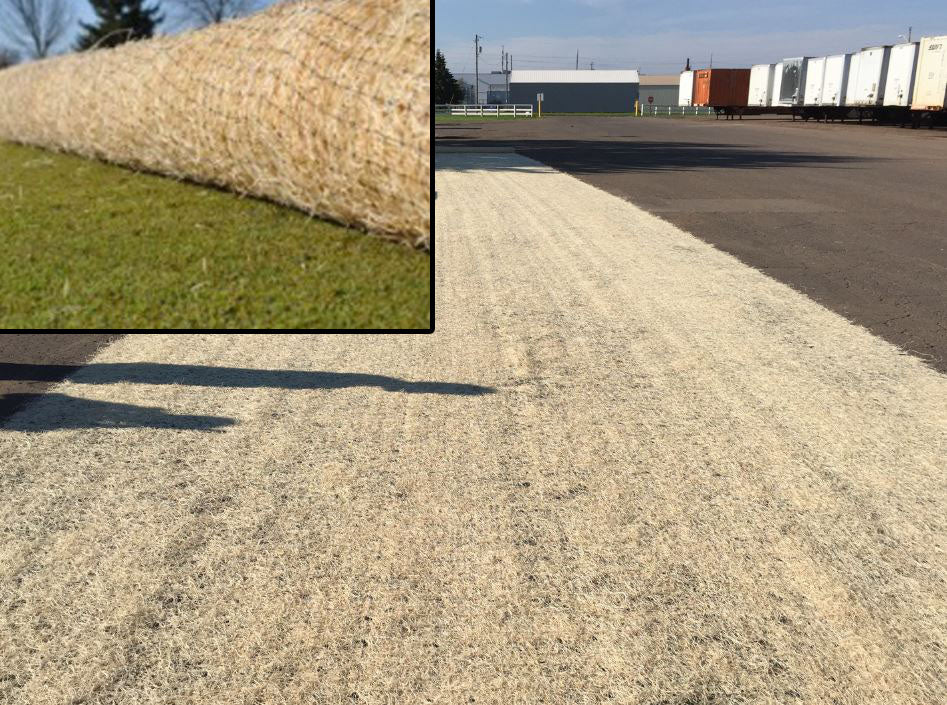
Erosion Control Blankets (ECB), also known as erosion control mats, are a temporary to semi-permanent solution for soil stabilization and retention. ECBs are commonly used in new construction and landscaping, or areas that have not yet developed natural ground-cover vegetation.
The primary purpose of an ECB is to supply a substrate where ground cover will grow, or to buy time to plant and grow native cover that will eventually root and stabilize the soil. They can be installed in non-ideal conditions such as the rainy season, or to retain moisture through hot summer months — useful year-round.
ECBs have a functional lifespan from 45 days up to 36 months depending on style and material. Many are biodegradable and/or photodegradable (they decay with UV sunlight) over time, and are favored for their inherently temporary life and lessened environmental impact.

The soil is cleared, seeded with native grass, then the blanket is rolled out and staked in place. Vegetation grows in and through the blanket as it slowly degrades, leaving the established cover behind. A favorite of municipalities and highway construction for embankments, ditch bottoms, and slopes wherever soil needs temporary stabilization without washing away.
Note: none of our ECBs contain grass seed — seed selection is best matched to your region.
Turf Reinforcement Mats (TRM) are an effective long-term solution for erosion control — a permanent option for stabilizing a slope, channel, embankment, or the area around a pipe inlet or outlet.
These mats are non-biodegradable and resistant to UV photodegradation. As a durable product they stand up well to service and maintenance equipment traffic, and are well suited to high flow rates from drainage inlets/outlets and stormwater runoff.
TRMs are generally heavier blankets rolled out and staked in place, built from a 3D synthetic woven-fiber construction rather than the natural-fiber ECB counterparts. We also carry permanent erosion matting made of continuous nylon filaments fused where they intersect for vegetated channels and slopes.

Steep slopes and channels where you want to permanently reinforce vegetation — typically steeper conditions than an ECB handles. Heavily sloped areas where ground maintenance and mowing are inaccessible are an ideal use case.
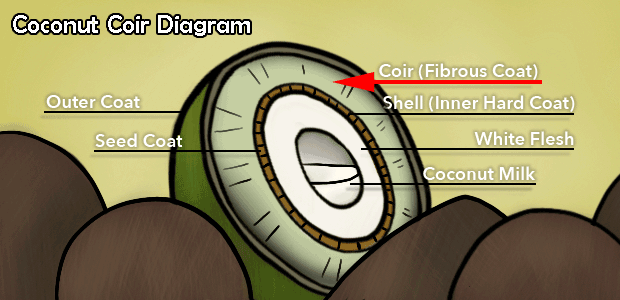
Coir is the fibrous "mantle" layer of a coconut, outside the hard shell and beneath the outer coat. Once considered waste, it's now popular for welcome mats, soil amendments, and erosion control — largely because it's both biodegradable and a sustainable resource.
Coir Mats function as Erosion Control Blankets — a subset of ECB providing a structured lattice for natural vegetation and seed to germinate through. They resemble an interwoven net of natural coconut-fiber yarn.
Coir Logs (or Coir Rolls) are bundles of coir fiber bound in mesh netting in tube form. Strong in tension, they help mitigate high-flow scenarios, shoreline erosion, break waves, lake shores, and general wetland stabilization — usable for inlet protection, check dams, perimeter control, sediment traps, and slope interruption. Free from chemical treatments and safe for surrounding wildlife, coir degrades within 2–5 years depending on conditions.

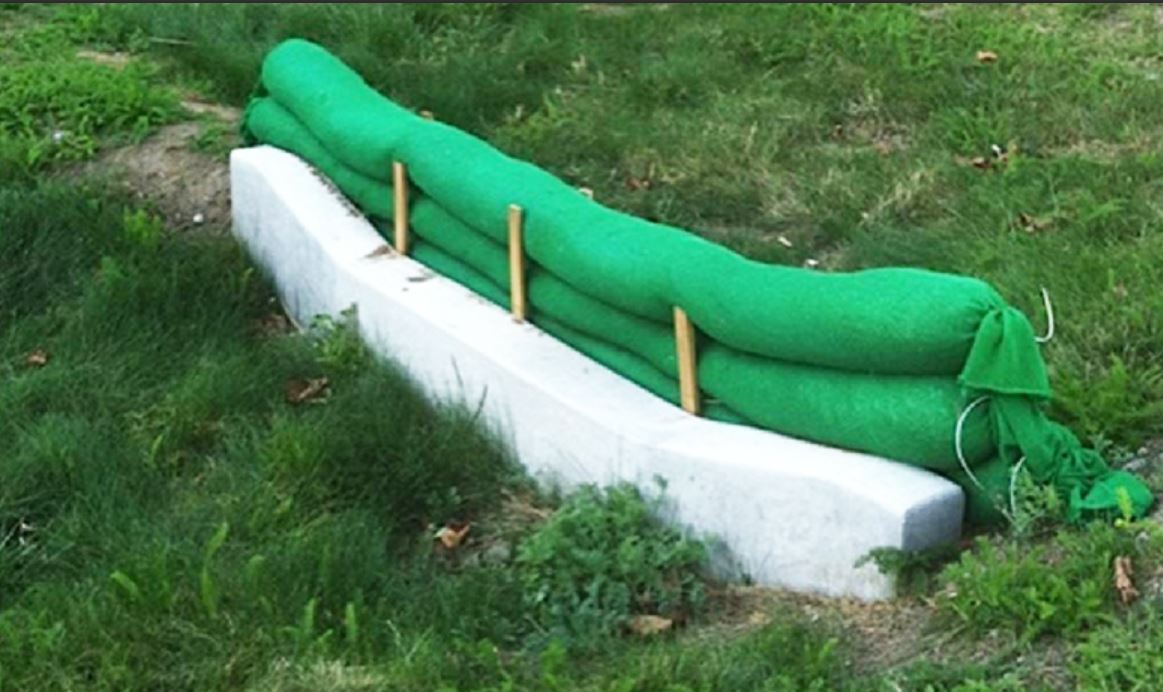
Silt Socks are woven plastic fabric tubes filled with wood chips or inert compost that filter sediment out of contaminated water before it reaches drains or waterways. Used at construction sites and new landscape installations to keep washout debris from clogging drains and polluting natural water bodies, they also serve as inlet protection and as check dams that slow stormwater runoff — a more effective alternative to silt fence.
Nonwoven geotextile is a fabric designed to let water pass through while filtering out solid soil particles and debris. Nonwovens are typically needle-punched and resemble felt in consistency, and come in large rolls used between layers of soil, asphalt, gravel, or other media. For erosion, geotextile fabric is a long-term solution.
For an erosion application, an 8oz or heavier nonwoven should be placed and pinned on an excavated hillside, then 4–5" of the excavated soil spread on top — sandwiching the fabric between soil layers. The permeable fabric lets water pass through while the soil is arrested in place. In extreme scenarios, pair it with other erosion control products.
Nonwovens are also common in drain fields, French drains, and behind retaining walls. Woven fabrics, by contrast, are used more under driveways, roads, and hardscapes.


No. All of our erosion control products are not pre-seeded. This is intentional — it's best to seed the soil first with whichever grass seed suits your area. Our blankets help that seed germinate and grow.
It depends on site conditions and your long-term goal. For a temporary solution that helps vegetation grow, use an Erosion Control Blanket. For a more permanent solution beyond three years, use a Turf Reinforcement Mat.
Most larger jobs have already specified an exact product. If you're not sure, talk to an engineer to determine what your job needs. The Erosion Control Product Finder also narrows it in three questions, and we're always available to talk through the options at (800) 583-4891.
713.17 Temporary Rolled Erosion Control Products. Furnish temporary rolled erosion control products conforming to Table 713-3 and the following. See the Erosion Control Technology Council website (ECTC.org) for commercially available conforming products.
Ultra-short-term mulch control netting — rapidly degrading photodegradable synthetic mesh or woven biodegradable natural-fiber netting.
Ultra-short-term net-less blanket — rapidly degrading natural or polymer fibers mechanically interlocked or chemically adhered into a continuous matrix.
Ultra-short-term single-net blanket or open-weave textile — degradable fibers bound by a single rapidly degrading netting, or rapidly degrading yarns woven into a matrix.
Ultra-short-term double-net blanket — fibers mechanically bound between two rapidly degrading synthetic or natural nettings.
Short-term mulch control netting — photodegradable synthetic mesh or woven biodegradable natural fiber.
Short-term net-less blanket — degradable natural or polymer fibers mechanically interlocked or chemically adhered into a continuous matrix.
Short-term single-net blanket or open-weave textile — degradable fibers bound by a single degradable netting, or degradable yarns woven into a matrix.
Short-term double-net blanket — fibers mechanically bound between two natural or synthetic nettings.
Extended-term mulch control netting — slow-degrading synthetic mesh or woven natural fiber.
Extended-term blanket or open-weave textile — slow-degrading fibers bound between two slow-degrading nettings, or slow-degrading yarns woven into a matrix.
Long-term blanket or open-weave textile — slow-degrading fibers bound between two slow-degrading nettings, or slow-degrading yarns woven into a matrix.
Answer three quick questions and the Product Finder points you to the right blanket, mat, or sock for your timeline and slope. Free shipping on every order.
Erosion Control Products are blankets, mats, tubular socks, or fabrics used to protect topsoil from erosion on slopes and embankments. Erosion Control Products range from temporary and degradable products to more permanent lifespans. These products are made from materials such as straw, wood fiber, and coconut.
Erosion is a natural occurrence that can be both environmentally damaging and costly if not prevented against. When large amounts of water wash away hillside soil it can be a nightmare to fix, and hillside erosion where homes or businesses are located can give way to landslides and property damage. Additionally having to dredge sediment filled waterways due to soil erosion costs the US government ~$1B per year on average since 2009.
In order to prevent hillside erosion and embankment soil loss, Erosion Control Products are recommended by federal and state municipalities along with private industry. These products are engineered to provide extra stability and allow time for natural vegetation to take root and secure the earth. The following article outlines the more popular erosion control solutions and where they are most effectively used.
Below you'll find a helpful chart to guide you to the appropriate product based on the anticipated project timeline. Further down you can find in-depth category descriptions with further product links and installation resources.
Eastgate Supply offers erosion control products to address your project needs, meeting ECTC and FHWA standards for Standards for Construction of Roads and Bridges on Federal Highway Projects. These solutions range from temporary applications 45-90 days to long term permanent installations of 5+ Years. We offer biodegradable products, and solutions for hard to maintain sloped hillsides and embankments.
If you'd like to speak with us regarding erosion control products please call us at (800) 583-4891 or email support@eastgatesupply.com
Answer a few questions to find the right product for your project.
Erosion Control Blankets (ECB) also known as Erosion Control Mats are a temporary to semi-permanent solution for soil stabilization and retention. ECBs are commonly used in new construction and landscaping, or areas that have not yet had a chance to develop natural ground cover vegetation.
The primary purpose of an ECB is supply a substrate where ground cover will grow, or to purchase additional time to plant/grown native ground cover that will eventually develop roots and stabilize the soil. These blankets can be installed in non-ideal climate conditions such as the rainy season, or helping to retain moisture in hot summer months, making them particularly useful year-round.
ECBs have a functional lifespan from 45 days up to 36 months depending on the style and material used. Many ECBs are biodegradable and/or photo-degradable (decay with UV sunlight) over time, and are favored because of their inherent temporary life with lessened environmental impact.
Erosion Control Blankets are primarily used on slopes/channels that need vegetation to eventually grow. The soil is first cleared, seeded with native grass, then the blankets are rolled out and staked in place. The vegetation will grow in and through them over time, and simultaneously the blankets slowly degrade and the new vegetation will remain.
Often ECBs are a favorite solution used by municipalities and local highway construction as they can be used for highway embankments, ditch bottoms, and slopes. The benefit of the ECB is its flexibility to use it wherever you want to temporarily stabilize soil and help vegetation to take root without worry of it being washed away.
NOTE: none of our ECBs contain grass seed.
Turf Reinforcement Mats (TRM) are an effective long term solution for erosion control. TRMs are a permanent option for stabilizing a slope, channel, embankment or an area around a pipe inlet or outlet.
These mats are non-biodegradable and resistant to photo-degradation from UV sunlight. As a durable product they stand up well to service and maintenance equipment traffic. TRMs are also well suited to handle high flow rates from drainage inlets/outlets, or storm water runoff scenarios.
Comparatively TRMs are generally heavier blankets that are rolled out and stake in place. The composition of these mats are usually of a 3D synthetic woven fiber construction rather than the natural fiber ECB counterparts.
We also have permanent erosion matting which is made of continuous nylon filaments fused where they intersect. This gives permanent turf reinforcement protection in vegetated channels, as well as on slopes.
Turf reinforcement mats are often used on steep slopes and channels where you want to permanently reinforce the vegetation the typically used on steeper sloped conditions than erosion control blankets. Heavily sloped areas where ground maintenance and mowing might be inaccessible is also an ideal use case.
Coir is the fibrous "Mantle" layer in a coconut that lies outside of the hard shell and beneath the outer coat of the fruit. This product was largely consider waste, but has become popular in the last few decades for its everyday use in welcome mats, soil amendments in gardening, and erosion control. Much of it's popularity comes from being both a biodegradable and sustainable resource.
Coir Mats function as Erosion Control Blankets and are a subset of ECB providing a ground cover structured lattice for natural vegetation and seed to germinate through. They are less of a mat and more resemble an interwoven net of natural coconut fiber yarn.
Coir Logs or Coir Rolls are bundles of coir fiber bound in mesh netting in the shape of tubes. these logs are strong in tension and can help with mitigating water in high flow scenarios, shoreline erosion , break waves, lake shores, or for general wetland stabilization.
Coir Logs come in different sizes and shapes, often times they are tube/fence like products that can be used for inlet protection, check dams, perimeter control, sediment traps and slope interruption. These units are free from chemical treatments are safe for surrounding ecology and wildlife. Coir will eventually degrade typically within 2-5 years depending on environmental factors.
Both coir Mats and Logs can be easily installed by staking them into the ground to protect a net carpet or coir berm depending on the products used. visit our coir page to view our full product line.
Silt Socks are woven plastic fabric tubes filled with wood chips or inert compost material that help filter out sediment contaminated water from entering other drains or waterways. These sediment reduction devices are used at construction sites and at new landscape installations to help prevent washout debris from clogging drains and polluting natural bodies of water.
Silt socks are also used for inlet protection around drains, and as check dams that will interrupt and slow storm water runoff.
Silt socks are a more effective alternative to silt fence.
Non-Woven Geotexile is a fabric material designed to let water pass through, but filter out the solid particles of soil and debris. Non-woven fabrics are typically made by a needle punched manufacturing process and resemble felt fabric in consistency.
These fabrics come in large rolls and are typically used in between layers of soil, asphalt, gravel, and/or other types of media.
Using geotextile fabric for erosion is a long term solution.
For an erosion application it is recommended that a 8oz or heavier weight Nonwoven fabric be placed and pinned down on an excavated hillside. After the fabric is pinned in place then 4-5" of the excavated soil should be spread out on top of the fabric sandwiching it between the soil layers. By embedding the permeable fabric on the embankment water is allowed to pass through the fabric layer and the soil is arrested in place, prevented from washing away. For extreme scenarios it may be advisable to this fabric in conjunction with other erosion control products.
Non-woven fabrics are also commonly used in drain fields, french drains, and behind retaining walls. Woven fabrics alternatively are more used for under driveways, roads, and hardscapes.
No. All of our erosion control products are NOT pre-seeded. This is intentional as we find it is best to have you seed the soil first with whichever grass seed is best in your area. Our blankets help the grass seed to germinate and grow.
This highly depends on the site conditions and what your long term goal is. If you want a temporary solution to help vegetation grow, use an Erosion Control Blanket. If you require a more permanent solution of greater than 3 years then use a Turf Reinforcement Mat.
Most larger jobs have either specified an exact product. If you are not sure, talk to an engineer to determine what is needed for your job. We are always available to talk through our products here at Eastgate Supply as well.
713.17 Temporary Rolled Erosion Control Products. Furnish temporary rolled erosion control products conforming to Table 713-3 and the following. See the Erosion Control Technology Council website (ECTC.org) for commercially available products that may conform to these specifications.
(a) Type 1.A, ultra-short term mulch control netting. Furnish a mulch control netting consisting of rapidly degrading photodegradable synthetic mesh or woven biodegradable natural fiber netting.
(b) Type 1.B, ultra-short term net-less erosion control blanket. Furnish an erosion control blanket composed of processed rapidly degrading natural or polymer fibers mechanically interlocked or chemically adhered together to form a continuous matrix.
(c) Type 1.C, ultra-short term single-net erosion control blanket and open weave textile. Furnish one of the following material:
(1) An erosion control blanket composed of processed degradable natural or polymer fibers mechanically-bound together by a single rapidly degrading, synthetic or natural fiber netting to form a continuous matrix; or
(2) An open weave textile composed of processed rapidly degrading natural or polymer yarns or twines woven into a continuous matrix.
(d) Type 1.D, ultra-short term double-net erosion control blankets. Furnish an erosion control blanket composed of processed natural or polymer fibers mechanically-bound between two rapidly degrading, synthetic, or natural fiber nettings to form a continuous matrix.
(e) Type 2.A, short-term mulch control netting. Furnish a mulch control netting consisting of photodegradable synthetic mesh or woven biodegradable natural fiber.
(f) Type 2.B, short-term net-less erosion control blanket. Furnish an erosion control blanket composed of processed degradable natural or polymer fibers mechanically-interlocked or chemically-adhered together to form a continuous matrix.
(g) Type 2.C, short-term single-net erosion control blanket or open weave textile. Furnish one of the following material:
(1) An erosion control blanket composed of processed degradable natural or polymer fibers mechanically-bound together by a single degradable synthetic or natural fiber netting to form a continuous matrix; or
(2) An open weave textile composed of processed degradable natural or polymer yarns or twines woven into a continuous matrix.
(h) Type 2.D, short-term double-net erosion control blankets. Furnish an erosion control blanket composed of processed natural or polymer fibers mechanically bound between two natural fiber or synthetic nettings to form a continuous matrix.
(i) Type 3.A, extended term mulch control netting. Furnish a mulch control netting consisting of a slow degrading synthetic mesh or woven natural fiber.
(j) Type 3.B, extended term erosion control blanket or open weave textile. Furnish one of the following material:
(1) An erosion control blanket composed of processed slow degrading natural or polymer fibers mechanically-bound together between two slow degrading synthetic or natural fiber nettings to form a continuous matrix; or
(2) An open weave textile composed of processed slow degrading natural or polymer yarns or twines woven into a continuous matrix.
(k) Type 4, long-term erosion control blanket or open weave textile. Furnish one of the following material:
(1) An erosion control blanket composed of processed slow degrading natural or polymer fibers mechanically-bound together between two slow degrading synthetic or natural fiber nettings to form a continuous matrix; or
(2) An open weave textile composed of processed slow degrading natural or polymer yarns or twines woven into a continuous matrix.
FHWA DOT highways FP-14 standards
Erosion Prevention Practices - Turf Reinforcement Mats
Harbor Dredging: Issues and Historical Funding