
Questions?
Call (800) 583-4891
Long-term erosion protection for slopes, channels, and high-velocity waterways — anchoring vegetation roots into a durable three-dimensional matrix where standard blankets won’t hold.
Turf reinforcement mats provide permanent erosion protection on slopes, channels, and swales by anchoring vegetation roots into a durable three-dimensional matrix. They handle high flow velocities where standard blankets won’t hold. Eastgate Supply stocks TRMs for the toughest erosion-control jobs, ready to ship.
Answer a few questions to find the right product for your project.
Overview
Excelsior (wood fiber)Excelsior matrix with polypropylene netting.
Coconut fiberCoconut fiber matrix with polypropylene netting.
Straw & coconutStraw and coconut mixed matrix with polypropylene netting.
Fully syntheticPolypropylene matrix and netting.
Grass Protection MeshUsed to reinforce turf from damage due to vehicular and pedestrian traffic. For use on flat areas.
High-Performance TRMs
This is a three-dimensional woven polypropylene geotextile. It’s designed with patented X3® Fiber Technology. It’s specifically engineered for superior erosion control on steep slopes and vegetated waterways. This mat offers the highest specification requirements for protection from erosion on slopes, banks, and channels. It is also the only High-Performance TRM to have a verified carbon footprint by an independent third-party. From beginning to end, the carbon footprint of 1m2 of the 75 HPTRM is 2.7 kg CO2 — equivalent to driving 7 miles.
Benefits of Pyramat
Applications
Highlights of the PM25 Mat
The 25 TRM model is a three-dimensional, woven polypropylene geotextile designed with the patented X3® Fiber Technology. It is specifically designed for superior erosion control on moderate slopes and vegetated waterways — ideal for moderate applications like flow channels, slopes, and stress conditions. It is UV resistant for the life of the product, up to 25 years.
View Pyramat collection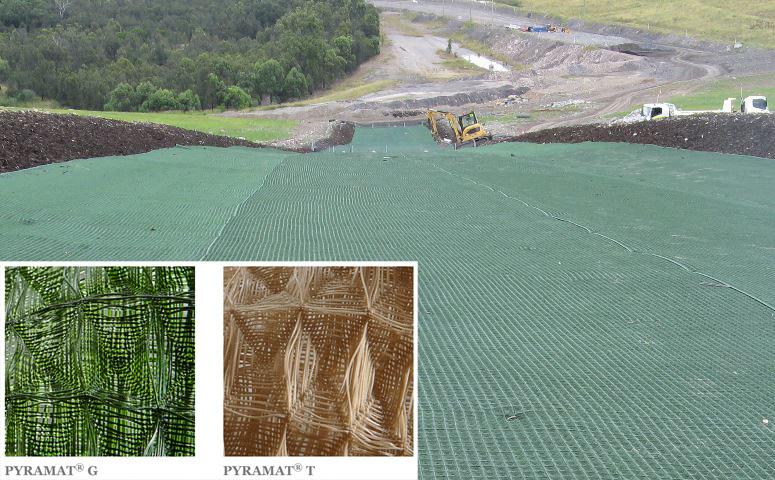
Medium-Grade TRMs
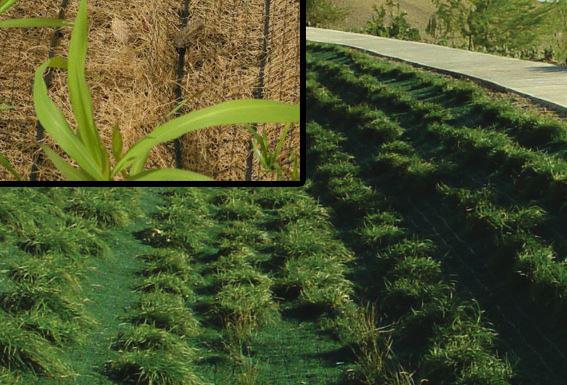
Landlok 450 with X3® Fiber Technology is a three-dimensional, woven or stitch-bonded polypropylene geotextile offering long-term protection from erosion. Vegetation is one of the most effective ways to control erosion. LANDLOK erosion control reinforces roots and stems to catch a great deal more sediment than your standard hard-armored options.
Applications
Features and Benefits
You get superior, long-term environmentally-friendly performance compared to rock riprap/rock armor or concrete paving. The woven construction is much stronger and more durable than first-generation TRMs that are laminated, fused, or netted. Patented X3® Fiber Technology provides a unique trilobal cross-section that grabs, captures, and traps soil, water, and seed more efficiently than standard fibers, and improves the development of seeding. It displays superior UV resistance, with easy installation that is more cost-efficient than standard erosion control procedures.
Savings and Advantages
LANDLOK® is designed for excellent performance and longer life expectancy while reducing installation and life-cycle costs. The LANDLOK® family of TRMs gives you up to 10 years of design life, soil protection, and improved environmental conditions to meet regulatory requirements — with increased savings over standard hard-armored solutions.
View Landlok collectionMost Degradable Option
These blankets are specifically designed to promote the ideal growing environment for grass seed and protect topsoil from wind and water erosion. American Excelsior Company is the leading inventor of biodegradable erosion control blankets since the early 1960s. The built-in swell factor allows the wet curled fibers to expand slightly in thickness, allowing for a strong fiber matrix that stays in close contact with the surrounding terrain. The flow of water is directed to follow the curled fiber matrix, so the roughness of the matrix slows the velocity until gravity allows moisture to seep into the topsoil, creating the perfect growing conditions.
About American Excelsior Erosion Control Blankets
These blankets are made with exclusive soft barbed interlocking curled Aspen excelsior fibers and are free of any weed seeds. A green color-coded plastic netting is available for applications that require strong, durable UV resistance. Photodegradable QuickMow™ netting is recommended for urban golf courses and some roadside projects, and for critically sensitive areas there is FibreNet™, a 100% biodegradable netting. Most fiber blankets on the market draw the line at 0.270 kg/m2 (.50 lb/yd2), but these are just under 0.400 kg/m2 (.75 lb/yd2), offering 50% more erosion control fibers. Available in natural Aspen or QuickGRASS green.
Curlex I – Single Net
A very carefully cut Great Lakes Aspen curled wood excelsior with 80% six-inch or greater fiber length, of consistent thickness with fibers evenly distributed throughout. The top of the blanket is covered with photodegradable or biodegradable netting and is free of all weed seeds or chemical additives.
Curlex II – Double Net
Another carefully cut Great Lakes Aspen curled wood excelsior with 80% six-inch or greater fiber lengths. Its overall thickness is consistent with fibers evenly distributed throughout, and the top is covered with photodegradable or biodegradable netting, free of all weed seeds or chemical additives.
View Curlex collection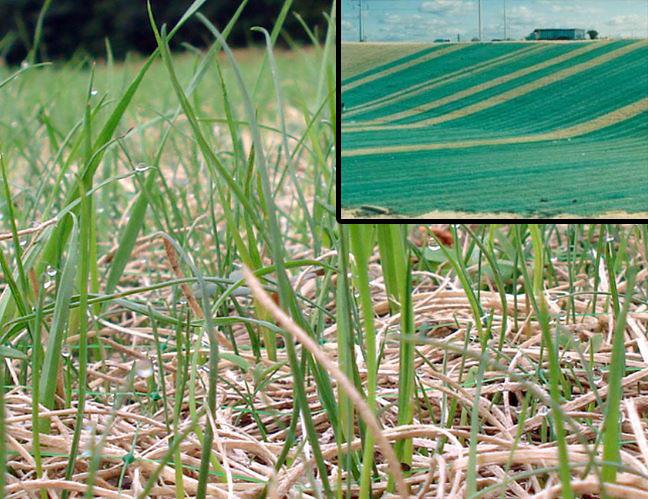
Technical Reference
Background ultraviolet light deterioration is the process in which the strength of a geotextile is damaged or reduced due to exposure to sunlight. When considering the cosmic ultraviolet background, each of these bands samples many different regions.
The type of geotextile and the location of exposure will affect the time it will take to degrade the geotextile. The deterioration is the same for all polymer materials. Deterioration from ultraviolet light happens when energy from the sun breaks the bonds inside the polymer structure. The energy from sunlight can be divided into three categories by wavelength (ultraviolet, visible and infrared).
Wavelengths above 400 nm form visible, infrared light but do not cause deterioration of the polymers used in geotextiles. For popular polymers used in geotextiles, the deterioration is usually caused by wavelengths in the UV range which is less than 400 nm.
Photons with longer wavelengths than the needed wavelength for any bond making up the molecular chains will not have an effect on the chemical structure and will not cause deterioration. Wavelengths that are less than 280 nm can be very damaging to polymer materials but are filtered by the earth’s atmosphere so they are not considered a factor.
There are several variables or fluctuations that affect the UV stability of geotextiles regarding the exposure of fabric and the environment. The local environment will have a significant impact on the rate of UV deterioration in respect to the intensity of sunlight and the temperature. Even the exposure of a slope’s orientation toward the sunlight can make a difference.
Through tests that were performed on Propex, geotextiles were exposed in three different locations in the U.S. Across the board, the southwestern area of the U.S is more severe than the southeastern area and the level of deterioration is a great deal less in the north. Manufacturers add a variety of stabilizers to geotextile fibers and yarns to increase stability. The level and nature of these stabilizers have an impact on the overall stability of the fabric. UV penetrates into the yarn or fiber from the surface toward the core.
Therefore, a larger diameter of fiber or yarn will degrade more slowly than a smaller diameter of the same composition. Woven geotextiles have a much coarser yarn which will degrade at a much slower pace than non-woven geotextiles. Since UV deterioration starts at the surface of geotextiles, a thicker fabric will also deteriorate at a much slower pace than thinner fabrics. Therefore, Propex non-woven Geotex® 801 (around 8 oz/sq. yd) will deteriorate a lot slower under the same conditions as Geotex® 351 (4 oz/sq. yd). Also, the difference in the deterioration rate is less obvious for non-woven geotextiles that are around 9 oz per square yard.
The standard process for analyzing the stability of UV in geotextile is provided in ASTM D-4355. For this process, the xenon-arc light source is used and specimens are exposed to the light under controlled conditions of temperature and humidity. This light source is very much like natural sunlight in the UV range. There are also exposure methods that use fluorescent light sources but are not approved for use on geotextiles. The xenon-arc exposure test is only considered an index test and the results cannot be used directly for the end use.
Although there seems to be a correlation between xenon-arc exposure and outdoor exposure, the results cannot be used directly. The test uses a combination of high light intensity and elevated temperatures to degrade the specimens at a quicker pace than would actually take place in a natural environment during the same period of time.
Samples are exposed for 500 hours and after exposure, a two-inch strip tensile strength (ASTM D-4632) is tested. This fabric is then compared to the properties of the unexposed fabric to determine the percentage of the original strength retained over a set period of time. Nationally recognized AASHTO M 288 specifications for geotextiles used in highway applications require minimum strength retention of 50% after 500 hours of exposure, vs the exposure of silt fence which should be 70% after 500 hours. All Propex geotextiles are stabilized to offer at least 70% strength retention after 500 hours exposure according to ASTM D-4355.
The best way to prevent UV light from deteriorating the geotextile is to prevent sunlight from reaching the fabric. Once the fabric is covered in soil, asphalt, or other material, the possibility for degradation will be removed. That said, the geotextile should be covered as soon as possible once the protective wrapper has been removed. Manufacturers of geotextile add stabilizers to the resin used to make geotextiles. These stabilizers make the polymers a great deal more stable to prevent UV light deterioration.
Stabilizers will limit the amount of deterioration for standard times but will not provide protection for extended periods of time. Project specifications should be in writing to limit the exposure to a maximum of 14 days in order to minimize UV degradation. If there will be longer required exposure times, samples of the exposed fabric should be tested from time to time to verify that a destructive amount of strength has not taken place. When shipped, the protective wrapper on rolls of geotextile should remain in place until the material has been installed.
Questions
To help prevent erosion on a slope as well as let vegetation grow on that slope.
All orders ship for free. Curlex ships from TX and Wisconsin; Landlok 450 and Pyramat ship from TN.
It depends on how temporary or permanent a solution you want, and how steep the slope is. Use the Erosion Control Product Finder above to match a mat to your project, or call us at Eastgate Supply to talk it through.
Each of the TRM product lines above has installation instructions on its individual page. Please click on the product to find the installation guides.
Use the Erosion Control Product Finder to match the right mat to your slope, channel, and flow conditions in a few quick steps. Free shipping on every order.