Questions?
Call (800) 583-4891

| Item | Qty | Unit |
|---|---|---|
| Configure your system on the left to see your parts list. | ||
Buyer's Guide · Trench Drains & Surface Water

A trench drain captures sheet flow across a line — a driveway, a loading dock, a plaza — and carries it to an outlet. ACO Drain is the modular, polymer-concrete standard for doing it cleanly.
Pick a channel family, a width, a grate to match your traffic, and the end caps and outlets to finish the run. Here's how the pieces fit. There are three channel families, and they map to the first step of the builder above.

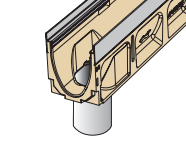
A trench drain is a long, narrow channel set flush with the surface. Water enters through the grate along its entire length, runs down the channel, and exits to a pipe or outfall — so you capture runoff across a line instead of hoping it finds a single spot drain.
ACO channels can be installed with a built-in continuous slope up to 130 ft (40 m), which accelerates flow and cuts ponding. The bodies are polymer concrete — a dense, non-porous composite (around 14,000 psi) that shrugs off freeze-thaw cycles, de-icing salts, and chemicals, which is why it outlasts formed concrete and plywood forms in wet, dirty environments.

The grate — not just the channel — determines how much load the drain can take. ACO rates grates to the EN 1433 scale, which climbs from Class A (pedestrian and bike areas) through Class C (cars, light service vehicles) up to Class E–F for severe duty like industrial yards, loading docks, and airport aprons, where Class F handles proof loads around 200,000 lb.
Match the class to your heaviest expected wheel load. Grates come in mesh, slotted, perforated, and ductile iron, with compliance options like heel-safe (≤ 0.25"), ADA, bicycle-safe, and anti-slip — the builder lets you filter by all of these so you only see grates that fit your channel.
Galvanized and stainless steel edge rails and grates are not compatible — pairing them causes galvanic corrosion and premature failure. Always match your grate material to the channel's edge rail. The system builder enforces this for you and will flag an incompatible combination before you add it to the cart.

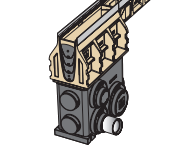
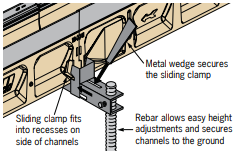
A working drain is more than channel. Each run needs channels for length (sections are about 39.37" / 1 m — count them to cover the distance), a grate, two end caps, and an outlet, plus optional pieces like an inline catch basin or installation devices for setting the channels during the pour.
Set your fall toward the outlet — aim for roughly 0.5–1% for self-cleansing flow; KlassikDrain offers pre-sloped and neutral channels, PowerDrain has a built-in 0.5% slope, and SlabDrain uses a flat invert so you grade the surrounding surface toward the channel and drop vertically through a bottom knockout. Match channel width to flow (4" suits most jobs; step up to 8" or 12" for high volume), and add about 10% for cuts and waste. Note that ACO orders carry a $750 minimum.
Examples to start from: ACO K100 KlassikDrain (4" general-purpose), ACO S100K PowerDrain (4" heavy-duty, Class F), and ACO SlabDrain (shallow, neutral-depth). Fiberglass FlowDrain and the paver-slot Brickslot are also available for special cases, all with free shipping.
Ready to build?
Use the Trench Drain System Builder above — choose a system, width, runs, grate, and accessories, and it assembles a live list of channels, grates, end caps, and outlets you can add to the cart in one click.
Common Questions
Pedestrians and bikes call for light duty (Class A). Parking aisles and delivery access step up to heavier ratings, and severe service like industrial yards and airport aprons reaches Class E–F. When in doubt, size for the heaviest wheel load that will ever cross the drain.
Galvanized steel is the value choice for general sites, stainless steel suits corrosive, wet, or coastal areas, and cast or ductile iron is best where impact and heavy wheel loads are frequent. Whatever you pick, your grate material has to match it.
Use heel-safe or tighter grate patterns where leaves and mulch are common, add upstream screens where applicable, and include accessible clean-outs or a sump box. An inline catch basin also traps sediment before it reaches your storm line.
Channel sections run about 39.37" (1 m) each, so count the number of sections needed to cover your run length, then add roughly 10% for cuts and waste. The builder above does this math for each run automatically.