
Questions?
Call (800) 583-4891
Get an exact count of mats and connector hardware for your project — instantly.
How the Count Works
Every DuraDeck mat covers a 4' × 8' area — 32 square feet. Divide your total coverage area by 32 to get a mat count, then round up. Connectors depend on your layout: a wheel-path road uses 2 connectors per mat, and a full-coverage platform uses 1 per mat.
The calculator above does this for you — pick a layout, enter your dimensions, and it returns the exact mat and connector count plus a top-down diagram. Note the order minimum: DuraDeck ships by the pallet, 30 mats minimum.
The Basics
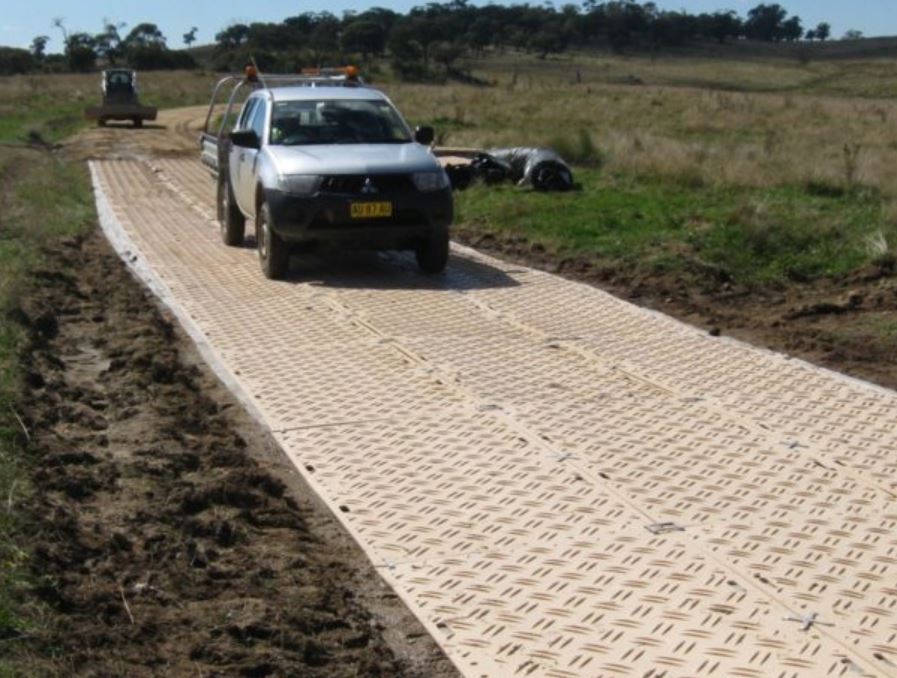
DuraDeck is a portable access mat used for turf protection, temporary roadways, and pedestrian paths placed over terrain that's otherwise not passable. The mats offer safe access for vehicles, equipment, and personnel across a wide range of construction and landscaping jobs.
Each mat is a single sheet of molded high-density polyethylene (HDPE) — durable, extremely strong, and lightweight at just 8.6 lbs, so one or two people can carry and place it without any special tools. Because it's solid molded material rather than layered, hollow, or laminated matting, there are no weak areas that can break, separate, or chip.
Choose Your Layout
The two layouts in the calculator cover the two most common jobs. Pick the one that matches how equipment or people will move across the mats.
Which Connector?
DuraLinks are quick to install and reusable; bolt-down locking plates give the most rigid connection for heavy repeated traffic. All four are stocked on the DuraDeck collection page — the calculator matches the right pair to your chosen layout automatically.
Mat Specs
Each mat covers 32 sq ft. Divide your area by 32 for a quick mat estimate before using the calculator.
Load capacity on a solid, flat sub-surface. Engineered flex lets the mat contour over uneven ground and return flat.
Per mat — light enough for one or two people to carry and position by hand, with no special tools.
Signature's limited warranty. HDPE construction is chemical- and weather-resistant with UV blockage that resists fading.
Where It Works
DuraDeck is designed for use without any ground preparation over gravel, soil, grass, concrete, asphalt, sandy soil, and mud. The two-sided surface adapts to the job: a rugged tread pattern for heavy equipment on one side, and a pedestrian-friendly, non-slip pattern on the other.
The rugged side uses two parallel treads set 90° from the adjacent treads, which keeps equipment from spinning out in wet, slippery conditions. For bridging open gaps like ditches, or for extremely rough terrain under heavy equipment, apply slow, even torque and use good judgment — the mats aren't rated to span open voids.

DuraDeck vs. Plywood
Plywood was never designed for vehicle traction or ground protection. Unlike plywood, DuraDeck won't absorb water, warp, or lose strength over time, and it won't rot or fall victim to termites. There are no splinters, loose nails, or broken boards to create safety hazards, and the material is recyclable and uniform in construction.
The cost math favors the mat over its lifecycle. A mat used 10 times a year across a 7-year life delivers roughly 70 uses; ¼-inch plywood typically gives about 5 uses before it's spent. To match 70 uses you'd buy 14 sheets of plywood — often more expensive in total than the mat, and without the traction, load rating, or reusability. See the full lineup and connector options on the DuraDeck collection page.
Using the Calculator

In the Field
When a defective pedestrian bridge in Middlesbrough, England had to be dismantled, the site was ringed by soft turf that heavy equipment couldn't cross. The contractor needed to position a 56-ton crane and a 30-ton loader alongside the bridge without tearing up the ground or laying an expensive temporary tarmac surface.
They chose DuraDeck, laying 165 feet of protected surface plus a separate 65-foot stretch to divert traffic. The mats supported the equipment and left the turf undamaged — five days after removal only slight grass discoloration remained, and two weeks later even that was gone. The job finished in a single weekend.
Common Questions
Yes — DuraDeck ships by the pallet, and the minimum order is 30 mats (one pallet). The calculator will show your project's mat count so you can see how it compares to the minimum.
Up to 80 tons on a solid, flat sub-surface. Actual capacity varies with the ground underneath; the engineered flex lets the mat contour over uneven terrain and then return to flat.
Gravel, soil, grass, concrete, asphalt, sandy soil, and mud — with no ground preparation required. They're not recommended for bridging open gaps such as ditches.
It depends on layout: a wheel-path road uses 2 connectors per mat, and a full-coverage platform uses 1 per mat. The calculator figures the exact count for your chosen layout and connector type.
The mats are made in the USA. Shipping is free on every order — no quote needed for freight.