
Questions?
Call (800) 583-4891
Woven and nonwoven geotextiles engineered for separation, filtration, drainage, soil stabilization, and reinforcement — built for roadways, drainage systems, and erosion control. Free shipping on every order.
Choose Your Fabric Type
Woven fabrics deliver high tensile strength for load support and stabilization. Nonwoven fabrics excel at filtration and drainage. Pick a path below to see the full range.
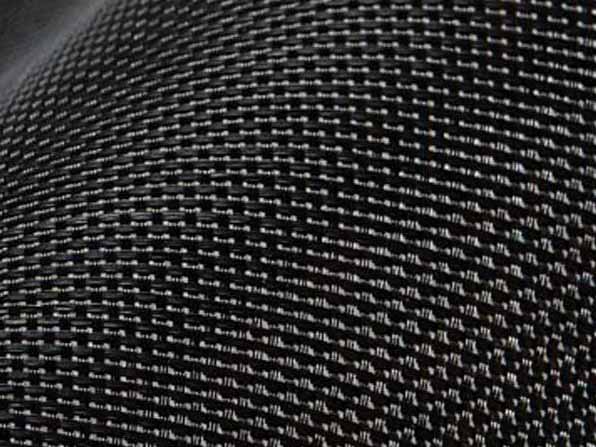
High tensile strength for subgrade stabilization, load distribution, and separation under roads, parking lots, and laydown yards. Includes Geotex 200ST / 250ST and close-match equivalents.
Browse woven fabrics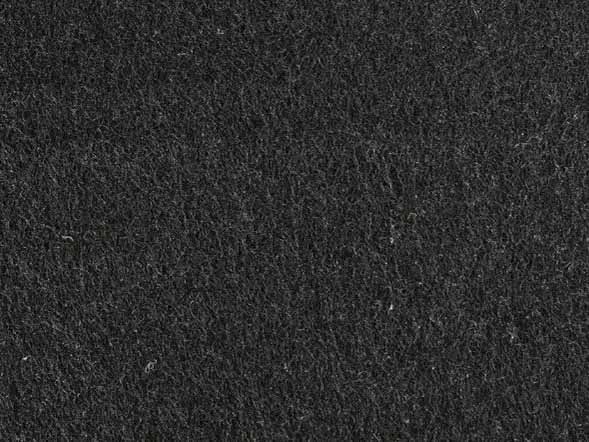
Needle-punched fabrics with excellent hydraulics and soil retention for subsurface drainage, filtration, and cushion protection. Available in weights from 4 oz through heavy grades.
Browse nonwoven fabricsInstallation Guide
With proper installation of Propex GEOTEX® geotextiles, you increase the performance of both paved and unpaved roadways — along with parking lots, airports, storage areas, and docks — by stabilizing the subgrade. The fabric works as an absorbent separation layer, preventing aggregate and subgrade from mixing as water passes through.
Geotextiles deliver three core functions in stabilization applications:
Keeps aggregate and subgrade soils from intermixing, extending road life.
Allows water to pass through while retaining soil — ideal for subsurface drainage.
Adds tensile support over soft subgrades, reducing required aggregate thickness.
Proper stabilization geotextiles can be used in almost all weather and temperature conditions. Careful planning and preparation at each step speeds construction and ensures greater performance. The guidelines below are general and suited to average construction conditions — specific site conditions, design requirements, or other situations may call for modifications, and critical applications should follow the project engineer's specifications.
Clear, level, and stabilize
Apply this step regardless of subgrade strength. First, clear all stumps, large stones, and other sharp objects that could puncture the fabric. Preparing roadway subgrade usually involves removing vegetation, roots, and subsoil.
Localized soft or unsuitable subgrade areas may need to be excavated and backfilled with suitable material. In very soft soil applications, leaving vegetation, roots, and topsoil in place can limit disturbance and preserve subgrade strength.
Roll, don't drag
It only takes two people to place GEOTEX® Stabilization Geotextiles. Roll the fabric onto the subgrade, starting where construction equipment has easy access and the layout plan allows. For very soft subgrade (CBR<1), start driveway fabric layout and aggregate placement on firm soil to establish an "anchor point," then roll the fabric onto softer sections. Do not drag the geotextile across the subgrade.
Usually the geotextile is laid in the direction of construction traffic, though project dimensions may require changes. Overlap panels side-to-side and end-to-end in the direction of aggregate placement — overlaps should range 1.5 to 3 feet depending on subgrade strength.
As an alternative, adjacent edges can be sewn instead of overlapped. Use sewn seams where the geotextile provides significant tensile reinforcement, such as very soft subgrade (CBR<0.5). Seam strength and fabric orientation are important design specs; for critical applications, place and sew panels per the engineer's specifications. Pre-sewn panels can be supplied from the factory.
Pins or soil can hold fabric edges and overlaps down until aggregate is in place. On curves, the geotextile can be folded or cut to follow the curve, keeping the fold or overlap in the direction of construction.

Spread, don't stress the fabric
Place and spread aggregate over the fabric using standard construction procedures and equipment. Use pins, rocks, and soil on the fabric edges to hold it down and prevent lifting during placement of the first aggregate. Use a tracked bulldozer — a ground-pressure model is recommended for work on soft subgrades.
Lift density should not be under 6 inches; the first lift should be thick enough to prevent rutting to less than 4 inches. While spreading, the bulldozer should blade into the lead and slightly upward to avoid stressing the fabric. Repeat for each load until the fabric is fully covered. Watching the aggregate layer rut helps the operator decide where additional aggregate is needed for stability.
On very soft subgrade, take care during placement so the fabric does not shift and the subgrade does not become overstressed. "Mud waves" can occur in very soft soils; these are usually not a problem if they do not heave above the aggregate base. Avoid sudden stops or turns over the geotextile, and under normal conditions, do not allow vehicles to drive directly on it.
If the fabric is damaged during installation, expose the damaged section and place a fabric patch large enough to overlap the damaged area, then replace and compact the aggregate.
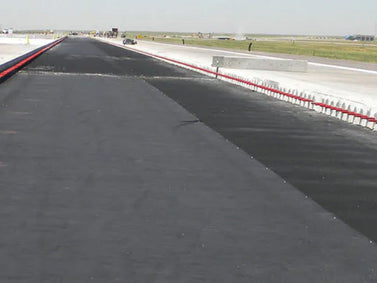
Compact to specified density
Compaction is required by project specifications. Compact aggregate by walking the tracked bulldozer back and forth over it while waiting for the next load; construction traffic will also help compact the aggregate until stability is reached. Achieve final compaction by rolling the area with a vibratory compactor — start with several vibrating passes, then move to full vibration.
If weak areas appear during final compaction, there is likely inadequate thickness there. Do not grade ruts down — fill them with additional aggregate and compact to the specified density. The same applies to any future rut maintenance.
Monitoring construction: It's important to monitor conditions throughout. If the subgrade has lower strength than the design predicted, re-evaluate the structural section thicknesses. Rutting in the aggregate layer can pinpoint weak subgrade areas so design adjustments can be made.
Nonwoven Geotextiles
Made from high-quality polypropylene staple fibers, needle-punched into a dimensionally stable network for separation and stabilization. Available in a range of styles to match your project's specifications.
Ideal for unpaved roads — increases performance life and reduces overall road-section thickness by using less aggregate during construction.
Excellent hydraulics and soil retention make GEOTEX nonwovens perfect for subsurface drainage systems and applications below hard-armor systems.
The same hydraulic and soil-retention strengths support filtration in containment and environmental drainage applications.
A highly visible bright-orange nonwoven barrier alerts workers to stop excavation in areas with buried contaminants or other hazards.
Questions


